





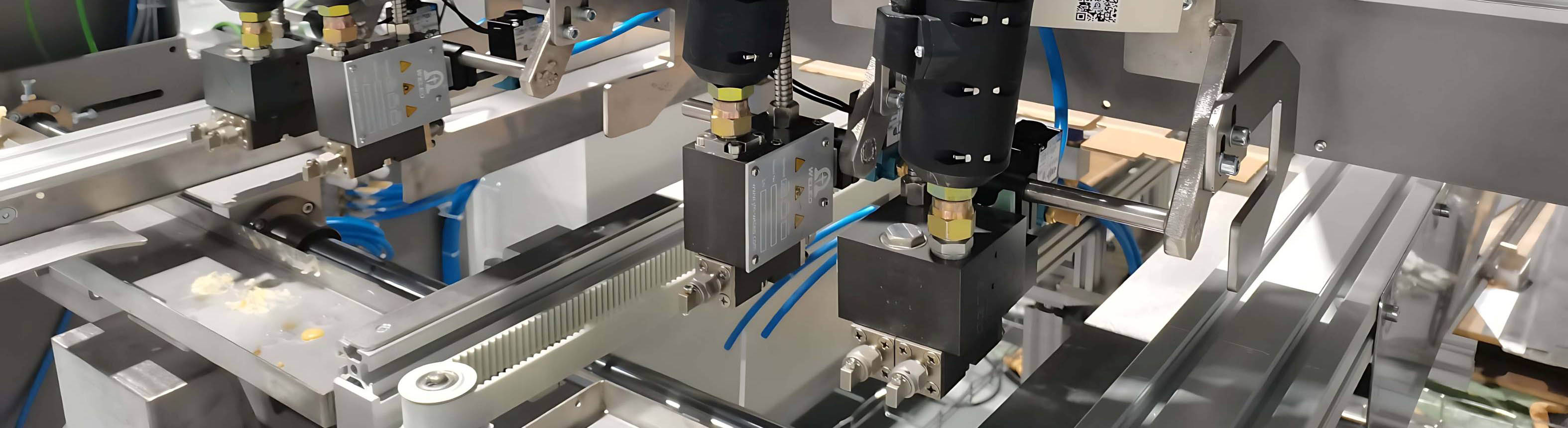
How To Choose A Metered Spray Dispensing System?
Metered spraying should deliver a defined adhesive quantity while maintaining the required coverage, bond strength, and edge control at production speed. Selection begins with the material and target coat weight, then moves through pump displacement, pattern geometry, motion control, and line integration.
Table of Contents
Define the Result Before Selecting Hardware
Start with the substrate width, bonded area, adhesive weight per product, allowable tolerance, line speed, and desired pattern. Paper, foam, textiles, non-wovens, labels, and automotive parts do not respond to the same spray structure.
Confirm Adhesive Behavior Under Working Conditions
Provide viscosity across the intended temperature range, softening behavior, open time, filler content, and sensitivity to heat or moisture. The spray module and orifice must pass the material without excessive pressure or frequent cleaning.
quantitative adhesive spraying equipment also needs sufficient heating capacity. Temperature drift changes viscosity, and changing viscosity affects atomization, pattern width, and measured output even when the pump speed remains unchanged.
Size the Metering Unit
A gear dosing unit should operate within a practical speed range during normal production. A pump that is too large may run slowly and lose resolution at low output. An undersized pump may remain near maximum speed, leaving little reserve for acceleration or wider coating.
Required delivery can be estimated from adhesive weight per product multiplied by production rate. The calculation should include the number of spray heads and whether they operate together or independently.
Coordinate Pumping, Spraying, and Motion
The metering pump controls adhesive volume; the spray module forms the pattern. Both must respond to line movement. A precise spray system for glue may use a servo-driven gear pump, speed reference, trigger input, and distance compensation to keep output stable as the conveyor accelerates.
Compare Configurations at the Correct Stage
| Production condition | Configuration priority |
|---|---|
| One stable pattern | Simple control and repeatable setup |
| Several product widths | Quick-change modules or recipes |
| Multiple independent lanes | Separate dosing or channel control |
| Existing melter available | Compatible standalone dosing platform |
| Small cartridge-fed process | Low dead volume and level monitoring |
| Robot application | Compact installation and motion integration |
This comparison should follow spray trials, because the required pattern and flow range determine whether one configuration can cover all products.
Plan Controls and Verification
Specify recipe storage, HMI access, low-level alarm, temperature monitoring, speed tracking, and fault output. Operators should be able to change approved products without altering protected calibration values.
Acceptance testing should compare commanded output with collected adhesive weight across low, normal, and high line speeds. Pattern width, edge definition, start-stop response, and repeatability should also be recorded.
WELEO configures each metered spray dispensing system around the adhesive, dosing range, spray module, substrate, and automation method. Supplying samples and real operating data allows the system to be tested against measurable coating results before final configuration.