





What Is A Precision Adhesive Dispensing System?
Modern manufacturing increasingly relies on controlled adhesive placement to achieve consistent bonding quality, reduced waste, and stable production efficiency. A precision system is designed to manage adhesive flow with strict control over temperature, pressure, timing, and volume, ensuring each drop or bead is delivered exactly as required by the process.
Table of Contents
Definition and Core Purpose
A precision adhesive dispensing system is an integrated solution that meters, transports, and applies adhesive with tightly controlled accuracy across repeated production cycles. Its main purpose is not only bonding materials but maintaining identical output behavior from the first product to the last in continuous operation.
In automated production environments, even small deviations in adhesive volume or position can affect structural strength, appearance quality, and downstream assembly performance. This makes precision control a core requirement rather than an optional feature.
System Architecture and Control Logic
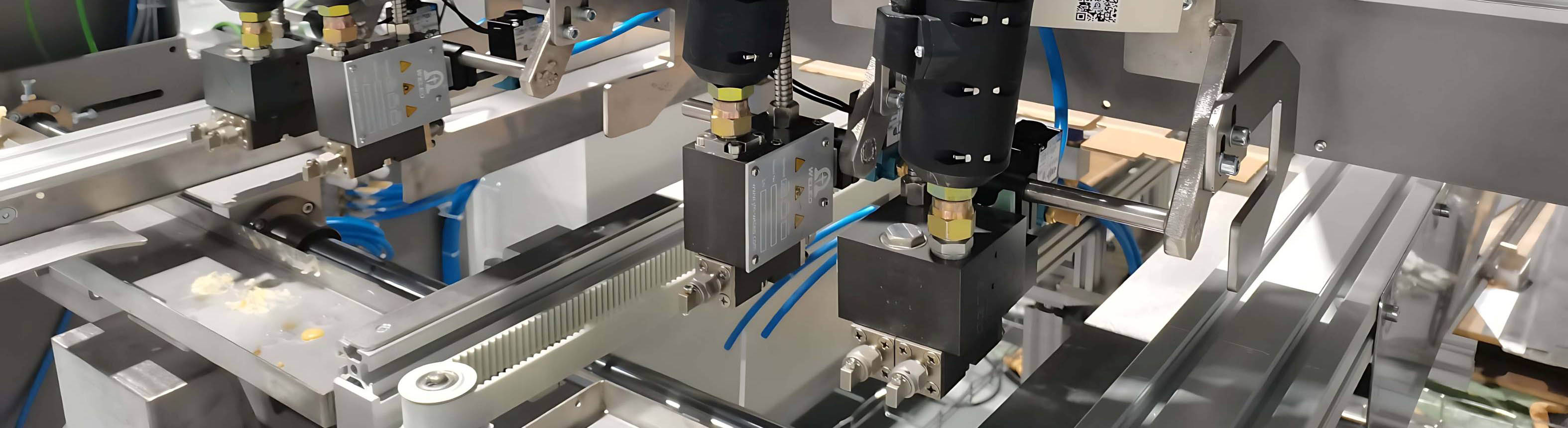
A typical system consists of a melting or storage unit, precision pump, heated or pressure-rated delivery lines, filtration components, application valves, and a programmable controller.
The controller coordinates signal timing with conveyor movement or robotic motion. The pump determines volumetric output. The valve defines opening and closing response. The nozzle shapes the final deposition pattern.
A high accuracy glue system depends heavily on stable coordination between these components. Any mismatch in timing or pressure can cause under-application, over-application, or irregular coating geometry.
Why Precision Matters in Industrial Production
In automated assembly lines, adhesive is often applied in milliseconds. Product movement speed can exceed 100 meters per minute in packaging or converting operations. At this speed, a delay of 10 milliseconds can shift adhesive position by nearly 17 millimeters.
This level of sensitivity means that mechanical stability and electronic synchronization must work together. A stable industrial dispensing control system ensures that signal delay, pump inertia, and valve response are minimized and predictable.
Key Performance Influencing Factors
Precision is affected by multiple interconnected variables rather than a single component.
Temperature stability is essential because viscosity directly influences flow resistance. Pressure fluctuation impacts dispensing consistency. Nozzle wear changes pattern geometry over time. Air bubbles or contamination disrupt flow continuity. Signal delay affects placement accuracy.
To achieve a stable result, each factor must remain within controlled limits throughout long production cycles.
Process Validation and Measurement Approach
Understanding what is precision glue system requires evaluating output rather than only equipment specifications. Real performance is measured by actual adhesive deposition consistency on the substrate.
Common validation methods include timed weight tests, pattern width measurement, and bond strength sampling. Repeated cycles are required to confirm that output remains stable over time rather than only at startup conditions.
Comparison of Control Levels
| Control Level | System Type | Accuracy Range | Application Focus |
|---|---|---|---|
| Basic control | Manual dispensing | Low | Repair or small batch |
| Intermediate control | Semi automated system | Medium | Standard production lines |
| Advanced control | Automated precision system | High | Continuous high speed manufacturing |
An accurate adhesive dispensing system typically belongs to the advanced level, where feedback loops and programmable logic ensure repeatability.
Integration in Modern Manufacturing Lines
Precision dispensing is rarely isolated. It is usually integrated into larger production systems involving conveyors, robotic arms, inspection cameras, and quality control sensors.
Material flow must synchronize with product position. System response must match machine speed. Output adjustment must adapt to changing product dimensions or line conditions without manual intervention.
This level of integration is what defines modern precision systems compared to traditional adhesive application methods.
WELEO Engineering Approach
WELEO develops complete adhesive handling and application solutions including melting units, gear pump systems, piston pump equipment, PUR reactive systems, cold glue platforms, Heated Hoses, filters, application guns, and nozzle assemblies.
Each configuration is designed based on adhesive type, viscosity range, required output accuracy, line speed, and application pattern. This ensures that dispensing performance remains stable across long production cycles and different working conditions.
Precision adhesive technology is ultimately about control consistency across time, not just momentary accuracy at startup.